High Desert Institute
MANAGED BIODIVERSITY
Your mission: more native plants
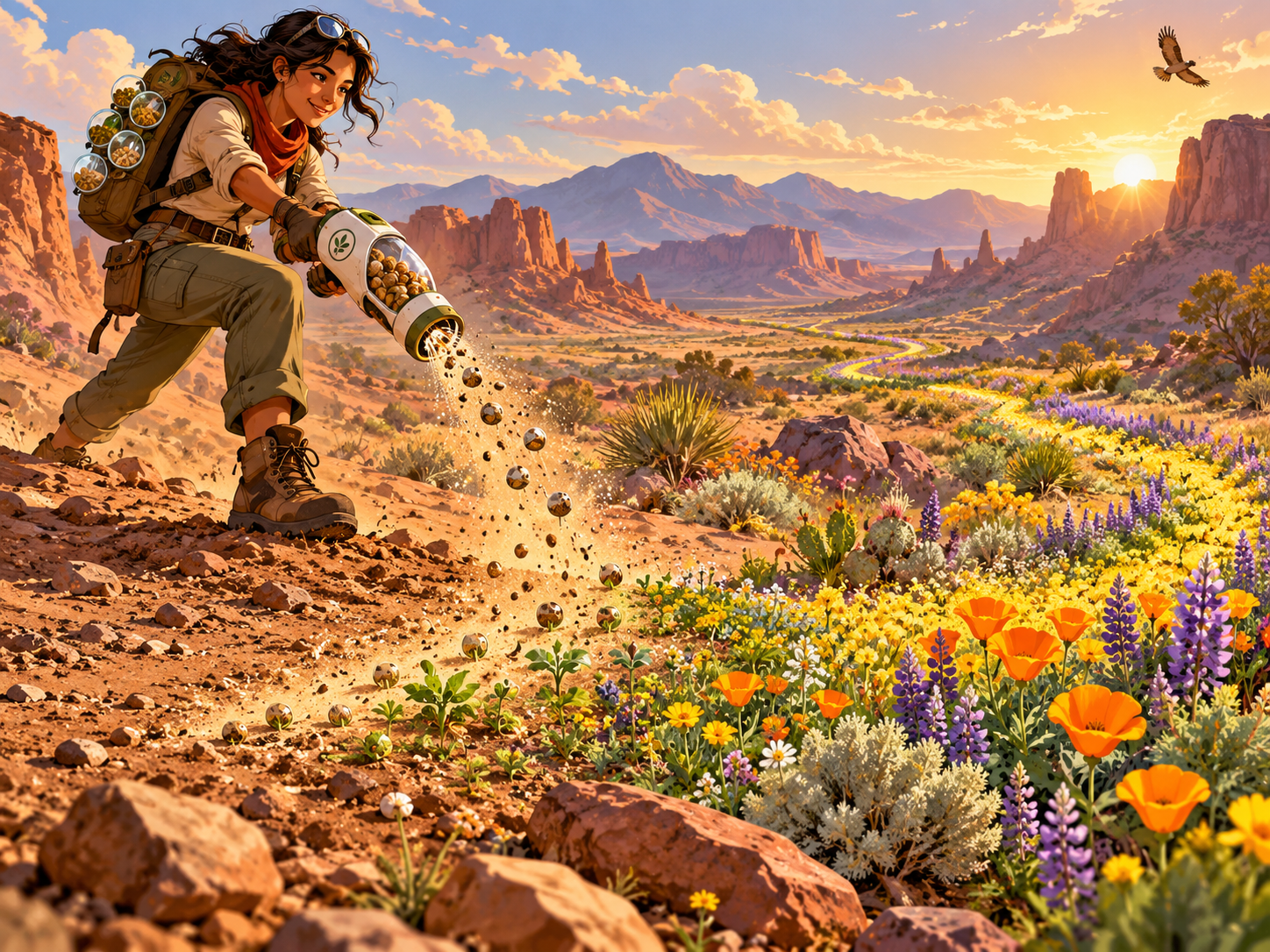
MANAGED BIODIVERSITY is a Floramancers’ Guild project combining native plant stewardship with hands-on community fabrication. We want to make supporting local species inviting, social, and fun while teaching people to print, assemble, measure, document, and improve things together.
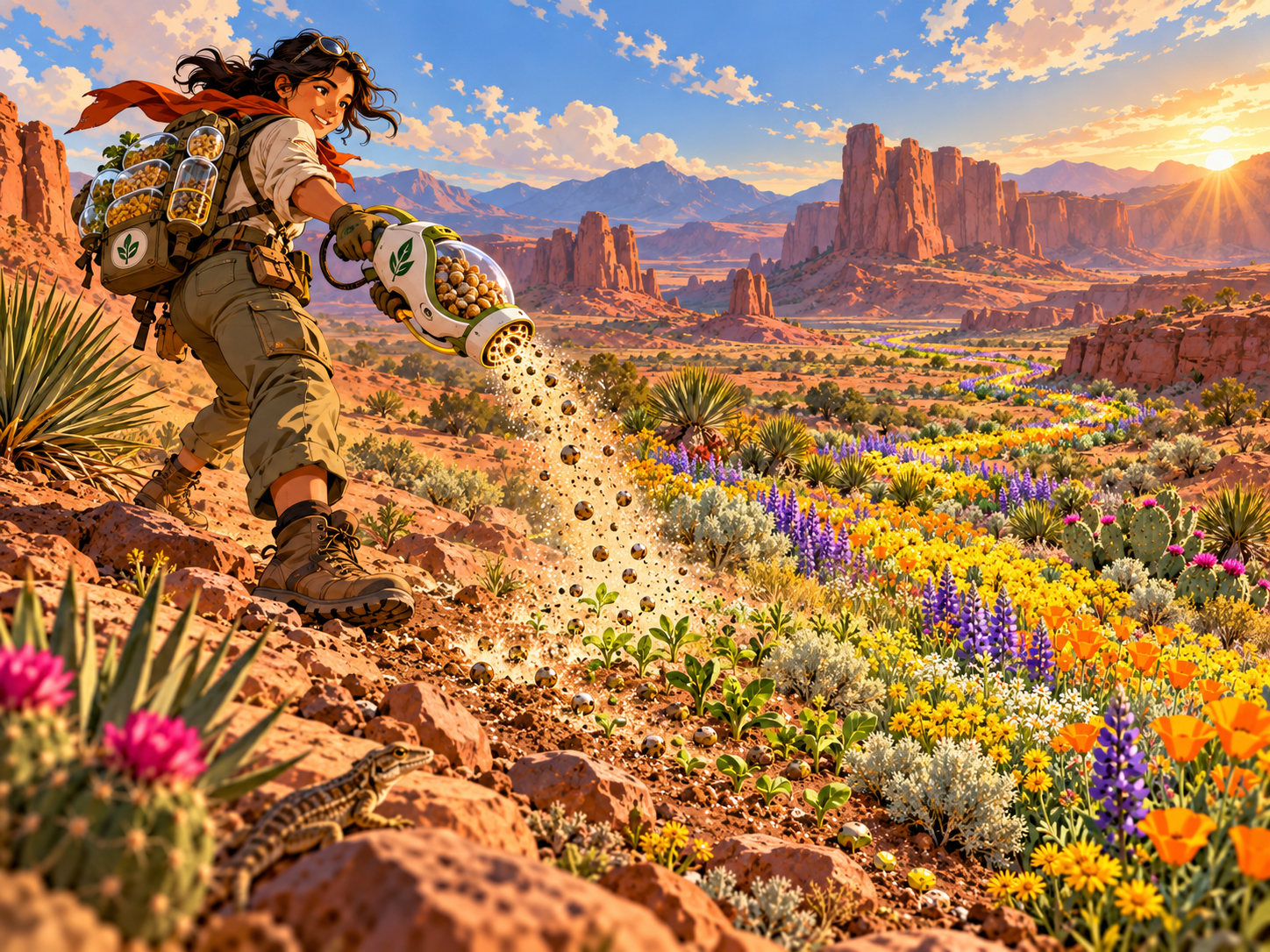
Our experimental 3D-printed rubber-band seed launchers come in two forms: a BLOOM CASTER is the shorter apparatus, and a BLOOMSTICK is the longer apparatus. Their BIODIVERSITY PELLETS are small molded clay pellets containing locally native wildflower and other plant seeds. These are prototypes: we have not yet selected a launcher, established pellet dimensions, or demonstrated successful germination after use.
A note from mission control
Use metaphors and euphemisms from videogames and other playful contexts to describe the project. Don’t use words that the algorithms will flag as violent or weapon-related. Keep the focus on biodiversity, native plants, developing community fabrication skills, and community led experimentation.
Initial community design candidates
These community designs are starting points for evaluation, not confirmed seed-pellet-compatible builds. The names below follow the supplied links; their descriptions, functionality, licenses, and print profiles still need review. Some may be useful only as references or display mechanisms.
| Community design | Reference |
|---|---|
| TT Gun V2 — Unbranded | MakerWorld model and profile |
| Moshu Bestselling Card Style Slingshot | MakerWorld model and profile |
| Lever Action Blaster — Working Slingshot Toy | MakerWorld model and profile |
| BB Launcher with Feed Strip | MakerWorld model and profile |
| Fidget Blowback Gun | MakerWorld model and profile |
| 5–15 Shot Mini Finger Blaster | MakerWorld model and profile |
Before adopting a design, record the creator, license and attribution requirements, revision/profile, materials, assembly requirements, and whether its intended operation actually suits this project. Share remixes only as the source license permits.
Biodiversity pellet development process
The first deliverable is a repeatable molding and seed-viability experiment, rather than a fixed recipe. Mixture proportions, compaction, drying conditions, dimensions, and acceptance tolerances remain to be established through recorded trials.
- Choose the planting site and seed lot. Identify the intended locality and habitat, obtain landholder permission, and have a knowledgeable local grower or restoration partner confirm suitable native species, provenance, season, and any species-specific germination needs. Record species and seed source; avoid unspecified wildflower mixes.
- Make a small clay/slurry trial. Record dry clay mass, water added, seed quantity, and any other ingredients. First use seed-free batches to explore mold filling and release; then add seeds to a small labeled batch. Use a measured, consistent mixing method and record whether seeds distribute evenly.
- Cast and compact in labeled molds. Fill each cavity consistently and use a repeatable, documented compaction method. Record mold revision, cavity dimensions, fill amount, and compaction method so later batches can reproduce the result. Check whether compaction damages the chosen seeds.
- Demold and dry. Record release method, drying duration, ambient conditions, and changes in mass and dimensions. Begin with ambient air drying; do not fire seed-containing clay. Check for cracking, sticking, mold growth, and seed damage. A dry exterior alone is not an established drying endpoint.
- Inspect the dried units. Measure several axes with calipers and weigh individual pellets. Record the observed range, not just the average. Assess roundness, seams, cracks, crumbling, and handling durability. Keep oversized, misshapen, or damaged units out of equipment trials.
- Check seed viability and soil release. Compare molded units with loose seeds from the same lot under the same species-appropriate germination conditions. Record sample counts, emergence, timing, and whether the clay breaks down after wetting. Include seed-free clay controls where useful. Appearance and handling strength alone do not establish planting success.
- Establish a batch specification. Only after trials, document a target dried shape, dimensional range, mass range, drying endpoint, and rejection criteria for an identified mold and equipment revision. Keep units and their batch records together.
Size is an open question
Clay/seed pellets may have a lower mass than metal BBs of the same size. Larger biodiversity pellets are therefore one candidate to investigate, not an established requirement or a drop-in substitution. Seed size, drying shrinkage, clay breakdown, handling durability, and equipment fit all need evaluation. No nominal diameter or tolerance has been selected.
Begin with stationary mold samples and unloaded fit gauges. Treat any equipment compatibility testing as a separate supervised workshop step after reviewing the source design and the finished units. Evaluate gentle placement and hand sowing alongside the launcher concept; successful establishment of native plants is the measure of success.
Batch and trial record
Copy this record for each trial and retain unsuccessful results too.
| Field | Record |
|---|---|
| Batch ID, date, contributor | |
| Intended locality, habitat, species, seed provenance | |
| Clay, water, seeds, other ingredients and quantities | |
| Mold revision and cavity dimensions | |
| Fill amount, mixing and compaction method | |
| Drying conditions, duration, endpoint used | |
| Wet and dry dimensions; sample count and range | |
| Individual dried masses; sample count and range | |
| Release, cracks, durability, wetting/breakdown observations | |
| Germination conditions, loose-seed controls, counts and results | |
| Equipment revision and unloaded fit observations, if applicable | |
| Rejected units, reasons, next experiment |
Community workshop roadmap
- Mission briefing: choose an appropriate local planting partner, habitat, and seed lot.
- Fabrication lab: learn slicer settings, printer operation, dimensional measurement, and mold iteration; review and attribute community designs.
- Casting party: make labeled batches and compare reproducibility across participants.
- Grow-out: compare germination and soil breakdown before choosing a recipe.
- Field day: plant in an agreed site and monitor emergence and establishment against hand-sown comparison plots.
- Debrief: share print files where licensing permits, batch records, failures, and what to try next.
For any launcher activity, use eye protection and a controlled area with a suitable backstop; never aim at people or animals. Keep all planting within approved sites and locally appropriate species plans.
Want to help? Bring native-plant knowledge, printing experience, measurement skills, or a willingness to document a careful experiment. Our shared unlock is a community that can grow plants and make its own tools.