High Desert Institute
Open Observatory
STEP ONE
The first thing you need to do is connect with existing local astronomical societies in your area. These groups are full of DIY experts who are already doing a lot of the things we are interested in doing, and full of high contributors who will be able to lead the community through many of these projects:
Arizona (High Desert / Colorado Plateau)
- Astronomers of Verde Valley (Cottonwood)
- Astronomy Association of Arizona (Buckeye)
- Huachuca Astronomy Club of Southeastern Arizona (Sierra Vista)
- Little Colorado River Valley Astronomy Club (Winslow)
- Lowell Observatory (Flagstaff)
- Prescott Astronomy Club (Prescott)
- Reach For The Stars (Vail)
- Sonora Astronomical Society (Green Valley)
- Sun City Oro Valley Astronomy Club (Oro Valley)
- Tucson Amateur Astronomy Association (Tucson)
California (Mojave & Great Basin High Desert)
- Antelope Valley Astronomy Club (Lancaster)
- Bear Valley Springs Astronomy Club (Tehachapi Mountains)
- Big Bear Valley Astronomical Society (Big Bear City)
- Death Valley National Park (Death Valley)
- High Desert Astronomical Society (Apple Valley)
- Kern Astronomical Society (Bakersfield - Arid basin border)
Colorado (High Plains & Colorado Plateau)
- Black Canyon Astronomical Society (Montrose)
- Colorado Springs Astronomical Society (Colorado Springs)
- Denver Astronomical Society (Denver - Semi-arid high plains)
- Estes Valley Astronomical Society (Estes Park)
- Longmont Astronomical Society (Longmont)
- Northern Colorado Astronomical Society (Laporte)
- Southern Colorado Astronomical Society (Pueblo)
- Western Colorado Astronomy Club (Grand Junction)
Idaho (Snake River Plain High Desert)
- Boise Astronomical Society (Garden City/Boise)
- Bruneau Dunes Observatory (Mountain Home)
- Idaho Falls Astronomical Society (Idaho Falls)
- Magic Valley Astronomical Society (Kimberly)
New Mexico (High Desert / Chihuahuan Plateau)
- Alamogordo Astronomy Club (Alamogordo)
- Amateur Astronomers Group (Alamogordo)
- Astronomical Society of Las Cruces (Las Cruces)
- Rio Rancho Astronomical Society, Inc. (Rio Rancho)
- Roswell Astronomy Club (Roswell)
- Santa Fe Stargazers (Santa Fe)
- The Albuquerque Astronomical Society (Albuquerque)
Utah (Great Basin & Colorado Plateau)
- Cache Valley Astronomical Society (Logan)
- Ogden Astronomical Society (Ogden)
- Salt Lake Astronomical Society (SLAS) (Salt Lake City)
- St. George Astronomy Group (St. George)
- Stellar Vista Observatory (Kanab)
- Utah Valley Astronomy Club (Orem)
Note: Almost all of these groups charge dues for membership. I think this is one of the biggest opportunities for community projects to fill a gap where most people are unwilling to participate if there is any cost at all. And if you need to fundraise, my experience has always been that you can raise plenty of money with a policy of no one turned away for lack of funds or one of asking people to pay what they want.
STEP TWO
Now that we know and understand what already exists in our area and we’ve started to build relationships with key stakeholders and project contributors, let’s start to build what our community is missing!
Community and Education
- Planetarium: Designs and software for DIY planetariums to host educational presentations about the night sky.
- Star Parties: Guides for planning and setting up power, red lighting, and seating for community observation events.
Providing Access To Basic Astronomical Tools
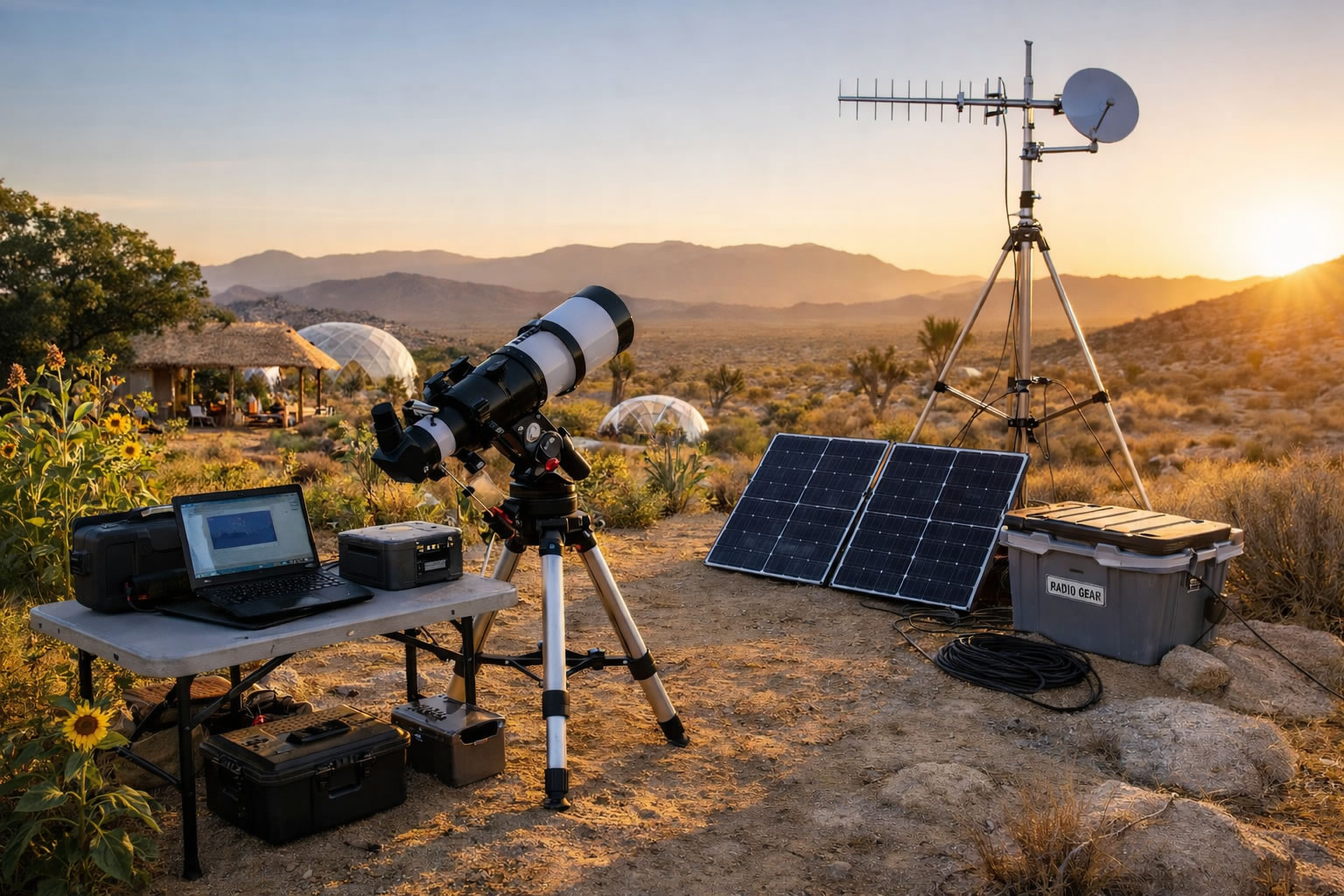
- Basic Optical Telescopes: Recommendations for telescope types, mounts, and enclosures suitable for public viewing and astrophotography.
- All sky cameras: Build weatherproof all-sky stations (visible + optional IR), run nightly pipelines, publish sky quality / cloud maps, meteor detections, and timelapses.
- Robotics around telescopes: One of the first things you realize when you look through a telescope is how fast the sky moves. Simple robotics projects can track the sky as it moves, enabling longer exposure photos and helping locate deep sky objects automatically.
- Basic Radio Telescope: Instructions for building and operating radio telescopes to observe the universe in the radio spectrum.
- Very Small Array: A project to build small radio interferometry arrays.
- Open Engineering: Salvaging and repurposing old satellite dishes and radio equipment for amateur astronomy.
Providing More Advanced Tools
- Higher-Powered Robotic Optical Telescopes:
- Radio Interferometry Arrays: Networking several radio telescopes is far more complex than setting up a single one, and it unlocks far more capabilities.
- Pulsar Detection and triangulation
- Gravity wave modeling
STEP THREE
Now that we have provided basic tool access (moving towards more advanced tools over time), we can start working on big, hard, long-term projects.
What can an observatory empower a community to work on and accomplish?
- Astronomical Modeling and Forecasting Publications: Many of the details of what’s happening in the sky depend entirely on where you are in the world at a given moment. This creates a huge opportunity for publishing local almanacs and forecasts of astronomical events (a la Stargazer’s Almanac) and optimal viewing times. Naturally, this segues into organizing community observation events like Star Parties.
- Sky clarity
- Meteor showers
- Star/Planet transits
- ISS transits
- Solar weather
- Lunar Illumination
- Ionisphere activity and signal propagation
- EME (Earth-Moon-Earth): Bouncing a transmission off the moon and having it reflecting back to the entire earth is actually not the hardest task. Doing it well gets progressively harder and harder.
- Public “ask for an observation” program: Students/community propose targets; your system schedules, captures, processes, and returns results—like a tiny open telescope network.
- Local-first + offline ops: Observatory runs without internet; syncs later. Robust UI, local docs, and “disaster mode” capability.
- End-to-end open pipeline: From capture → calibration → solving → stacking → photometry/astrometry → publish. With reproducible configs.
- Coordinate with universities / amateurs on campaigns
- Transits, occultations, supernova follow-up, comet outbursts—requires governance, training, and reliability.
- Host “calibration weekends”
- Annual/seasonal calibration events: standard stars, instrument characterization, shared procedures—build a culture of measurement.
- Community “signal atlas”: Tie radio astronomy + spectrum awareness together: map local transmitters, identify unknown signals, teach RF literacy alongside cosmic sources. This connects to the pathfinders’ guild and its networking efforts, including the Cyberpony Express.
Goals
- Accessibility: Make high-quality astronomical tools and knowledge accessible to everyone.
- Education: Foster a deeper understanding of the cosmos through hands-on learning and observation.
- Community: Create hubs for collaboration among amateur astronomers, students, and the general public.
The Open Observatory project is an evolving resource, with contributions from the Astromancers’ Guild and the wider open-source community.
Interesting Links
- Astra - An open-source software suite for controlling and automating astronomical observatories, designed to be user-friendly and adaptable for various hardware configurations.
- ExploraDome - An expensive but highly advanced robotic observatory system. Something to mimic rather than buy, but it is interesting to see how far you can push the capabilities of a small, robotic observatory system.